
Walk through Clovelly or almost any part of Sydney’s Eastern Suburbs today and it’s easy to forget that many of the area’s multi-million-dollar homes were originally bought simply to raise a family.
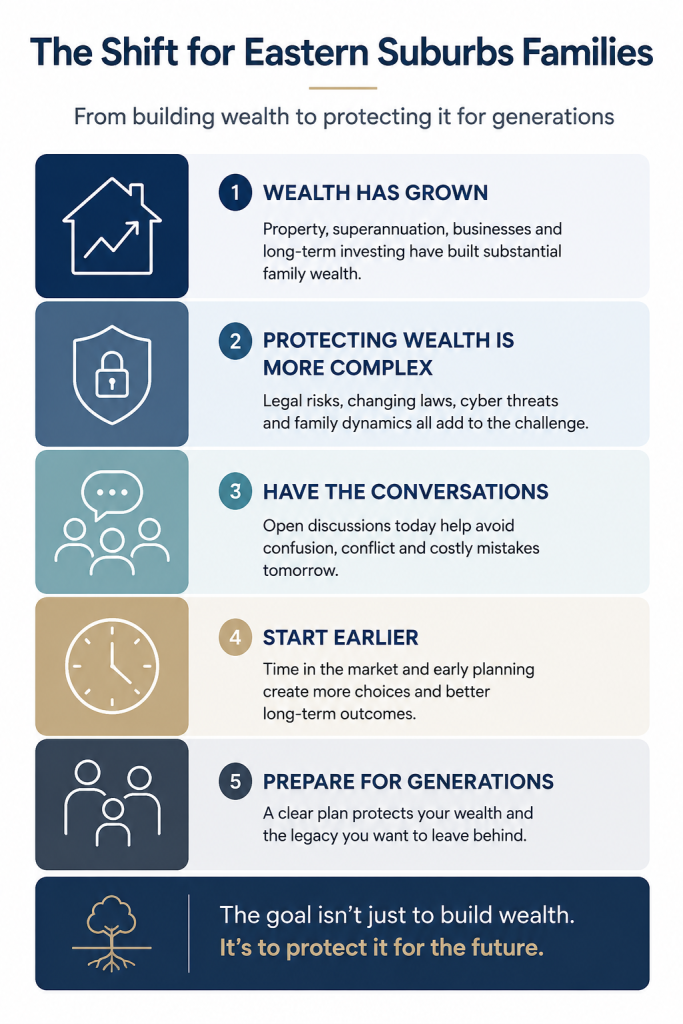
Over the past three decades, rising property values, compulsory superannuation, business ownership and long-term investing have quietly transformed the financial position of many local households. Along the way, many families have accumulated substantial wealth without necessarily thinking of themselves as wealthy.
For many families, the biggest challenge is no longer creating wealth. It’s making sure that wealth survives the next generation.
It’s also part of a much broader national story. Australia’s superannuation system now holds about $4.4 trillion in assets, with self-managed super funds accounting for more than $1 trillion. At the same time, the Productivity Commission projects Australia will experience one of the largest intergenerational transfers of wealth in its history as accumulated household wealth passes between generations over the coming decades.


Mark Taylor, Principal of Stirling Warton Taylor, says many of the conversations his firm has with clients today begin well before investments are discussed. Rather than beginning with products or investment returns, he says those conversations increasingly centre on protecting wealth, structuring it appropriately and preparing it for the next generation.
“People often become focused on trying to time investment markets,” Mr Taylor says.
“We encourage clients to think about time in the market rather than timing the market. Long-term wealth is generally built through patience, disciplined investing and having the right structures in place.”
Looking Beyond Performance
Investment performance matters, but Mr Taylor says many of the biggest financial decisions are made well before an investment is ever selected.
One misconception he encounters regularly is the belief that investing should wait until the mortgage has been paid off.
“People often tell us they’ll start investing once the mortgage is completely paid off,” he says.
“Our view is that long-term investing and reducing debt don’t necessarily have to be separate goals.”
In his experience, successful long-term planning begins with clear objectives and an appropriate financial structure rather than trying to predict short-term market movements.
Why Protecting Wealth Has Become More Complex
Building wealth is only one part of the equation. Protecting it has become just as important.
The Australian Government’s Retirement Income Review found many Australians struggle to navigate the retirement income system, often delaying important financial decisions or failing to make the most of the assets they already have.
Protecting wealth now extends well beyond investment returns. Family circumstances change. Businesses evolve. Tax legislation changes. Cybercrime and financial scams continue to become increasingly sophisticated.
The National Anti-Scam Centre reported Australians lost more than $2.18 billion to scams during 2025, with investment scams accounting for the largest category of reported financial losses.
“The world has become far more litigious over the past twenty years, while scammers have become increasingly sophisticated,” Mr Taylor says.
“It can take decades to build an investment portfolio, yet in some circumstances people can lose substantial amounts surprisingly quickly if appropriate protections aren’t in place.”
Mr Taylor believes one of the biggest mistakes people make is relying solely on general financial information found online.
“Social media can be useful for generating ideas, but important financial decisions deserve professional advice that reflects an individual’s own circumstances.”
The Family Conversation Many People Avoid
Retirement planning often receives plenty of attention. Succession planning, however, is frequently left until much later. According to Mr Taylor, that’s one of the greatest risks facing successful families.
The Productivity Commission expects intergenerational wealth transfers to accelerate over coming decades, yet many families still delay conversations about how that wealth should eventually be managed and passed on.
“As families become more complex and wealth grows, the next generation needs to understand not only what structures exist, but why they exist.”
“Too often families never explain the philosophy behind their investments or how those structures are intended to operate.”
That lack of communication, he says, can create unnecessary confusion and disputes later.
“A well-prepared succession plan isn’t simply about transferring assets.”
“It’s about transferring knowledge.”
Starting Earlier Makes a Difference
Many Australians still view retirement planning as something to think about in their late fifties or early sixties. Mr Taylor believes that mindset can significantly reduce future opportunities.
“Retirement planning shouldn’t begin at sixty.”
“It should begin much earlier.”
“The greatest advantage many investors have isn’t finding the perfect investment. It’s allowing quality investments sufficient time to grow.”
For many families throughout Clovelly and Sydney’s Eastern Suburbs, decades of hard work have already produced substantial wealth through property, superannuation, businesses and long-term investing.
The question increasingly isn’t simply how to build more wealth.
It’s whether that wealth has been properly structured, protected and prepared for future generations.
As Australia’s retirement system continues to mature and family wealth grows, those conversations are likely to become even more important—not simply because Australians are becoming wealthier, but because preserving that wealth has become more complex.
About Stirling Warton Taylor
Established in 2004, Stirling Warton Taylor advises business owners, professionals and families on tax-effective wealth structures, self-managed super funds, asset protection, retirement planning and succession planning.
Published 26-June-2026
SWT is a Proud Promotional Partner of Clovelly News.
This article contains general information only and should not be considered personal financial advice. Whether a self-managed super fund or any particular financial structure is appropriate depends on individual circumstances. Readers should seek professional advice before making financial decisions.